When is a digital safety process effective?
A digital safety process in field service is effective when the intended protective measures function reliably in real-world operations. This includes ensuring that relevant information is available, deviations are detected, the right people are reached, measures are initiated, and incidents are closed out in a traceable manner.
Regularly auditing the entire workflow is therefore crucial. Occupational health and safety laws require employers to verify the effectiveness of implemented safety measures and adjust them as necessary.
The risk assessment provides the technical foundation for this. We explain in more detail how this translates into concrete feedback, status, and escalation processes in our article Implementing risk assessments: How planning becomes an effective safety process.
Key takeaways at a glance
- Simply introducing a safety process does not prove its long-term effectiveness.
- What matters is whether the defined workflow functions under real-world operating conditions.
- Execution, responsiveness, responsibilities, and documentation should all be audited.
- Tests and trial alarms help identify vulnerabilities early on.
- Deviations should lead to concrete adjustments.
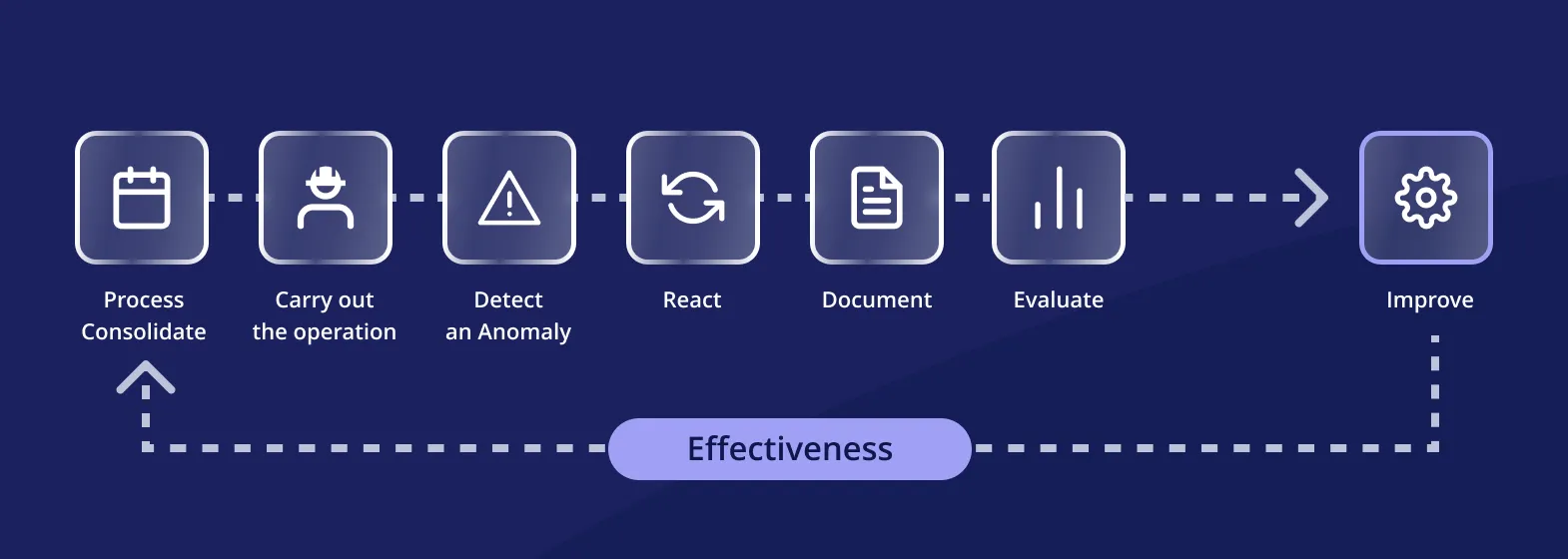
- Effectiveness auditing is a recurring cycle of Applying, auditing, improving, and re-testing.
Why implementation alone does not guarantee safety
A safety process can be perfectly planned and digitally mapped, but its true quality only becomes apparent during day-to-day operations.
An escalation rule is of little use if the person responsible is unreachable. A required check-in fails its purpose if it is consistently missed during certain tasks. And an alarm remains incomplete if the process is not followed by a clear resolution.
Does the intended process work under the conditions in which employees actually work?
The Federal Institute for Occupational Safety and Health describes effectiveness monitoring as an integral part of risk assessment. This involves checking whether measures have been implemented, whether they achieve the desired safety objective, and whether they need to be adjusted.
How can you determine the effectiveness of a safety process?
When evaluating a system, the number of features it offers is less important than whether the intended workflow functions reliably during an operation.
1. Intended steps are carried out
Log-ins and log-outs, status updates, or regular check-ins should be performed as intended for the specific operation.
If check-ins are repeatedly missed, it is worth analyzing the root cause: Is the process too cumbersome? Does the defined time window fit the task? Are requirements and responsibilities clear?
2. Deviations are detected in time
A safety process must make it visible when the planned course of action is deviated from. Typical deviations include:
- a missed check-in
- an exceeded operation duration
- a triggered alarm
- an interrupted process
- a technical malfunction
The article shows how such deviations can be evaluated and managed during multiple parallel operations: Escalation processes in field service.
3. Responsible persons are able to react
A technically correct notification is not enough on its own. The decisive factor is whether a responsible person is actually reachable and knows what action is required. This also includes coverage arrangements for vacations, illness, shift changes, or other absences.
4. The process is concluded in a traceable manner
A complete safety process requires a clear outcome:
- Was the person concerned reached?
- What measures were initiated?
- Was further escalation necessary?
- When was the process completed?
The article covers which data and events are relevant for this verification: Verifying safety processes in field service: Which data and key figures count.
Which criteria should companies review regularly?
Concrete process questions help with effectiveness monitoring:
These criteria do not replace a risk assessment. Which requirements are relevant depends on the activity, the risk, and the operational organization.
For a detailed evaluation of events and key figures, the article on the verifiability of safety processes provides the appropriate in-depth information.
How can a digital safety process be tested in practice?
An effectiveness test should reflect real-world conditions as accurately as possible. A process tested only under ideal conditions may still reveal weaknesses during actual use. Therefore, regular test alarms, tests at different locations, and exercises with various responsible persons are useful.
In doing so, the following should be deliberately checked:
- What happens if there is no response?
- Is the right person informed?
- What happens if this person is unavailable?
- Does the next escalation level work?
- Is the necessary operational information available?
- Does the process still work when multiple incidents occur simultaneously?
- How is limited mobile network coverage handled?
- Can the entire process be fully reconstructed afterwards?
Whether a security process works under real-world conditions also depends on the emergency response organization as a whole. Information, responsibilities, authorizations, and response paths must be available at the right time. This is precisely the perspective addressed in the article Operational Excellence in Technical Field Service: An operation is only truly ready for deployment when the prerequisites work together throughout the entire process.
What should happen after a deviation is identified?
A deviation is particularly valuable when it leads to a concrete improvement.
First, it should be clarified why the intended process did not work:
- Was a responsibility unclear?
- Was a time frame unrealistic?
- Was a notification overlooked?
- Were there technical difficulties?
- Did the defined process not fit the actual operational situation?
Subsequently, the affected process should be specifically adjusted:
- Determine the cause and the affected process step.
- Adjust the responsibility, configuration, or workflow.
- Inform affected individuals about the change.
- Document the change in a traceable manner.
- Retest the adjusted process under realistic conditions.
This creates a continuous improvement process.
Example: The escalation chain works technically, but not organizationally
A technician is working alone at a technical site. A check-in is required after a set amount of time. The check-in does not occur. The system detects the discrepancy and notifies the responsible supervisor as planned. However, a test alarm reveals that the supervisor is unavailable that day, and no substitute was designated for their role. The technical detection works, but the overall process is still not sufficiently effective.
The test results in concrete measures:
- Add a substitution policy
- Define the next escalation level
- Verify contact details
- Retest the procedure
This example shows why the effectiveness of digital safety processes must always be evaluated based on the interaction between technology, roles, and organizational workflows.