The chain of events for a verifiable field service safety process
Blog

Demonstrating field service safety processes: Which data and KPIs matter

01.09.2026

A check-in process is defined, responsibilities are assigned, and escalation paths are outlined. The organizational framework is in place. For ongoing management, one question remains: What information proves that the process functioned as intended during a specific field assignment?

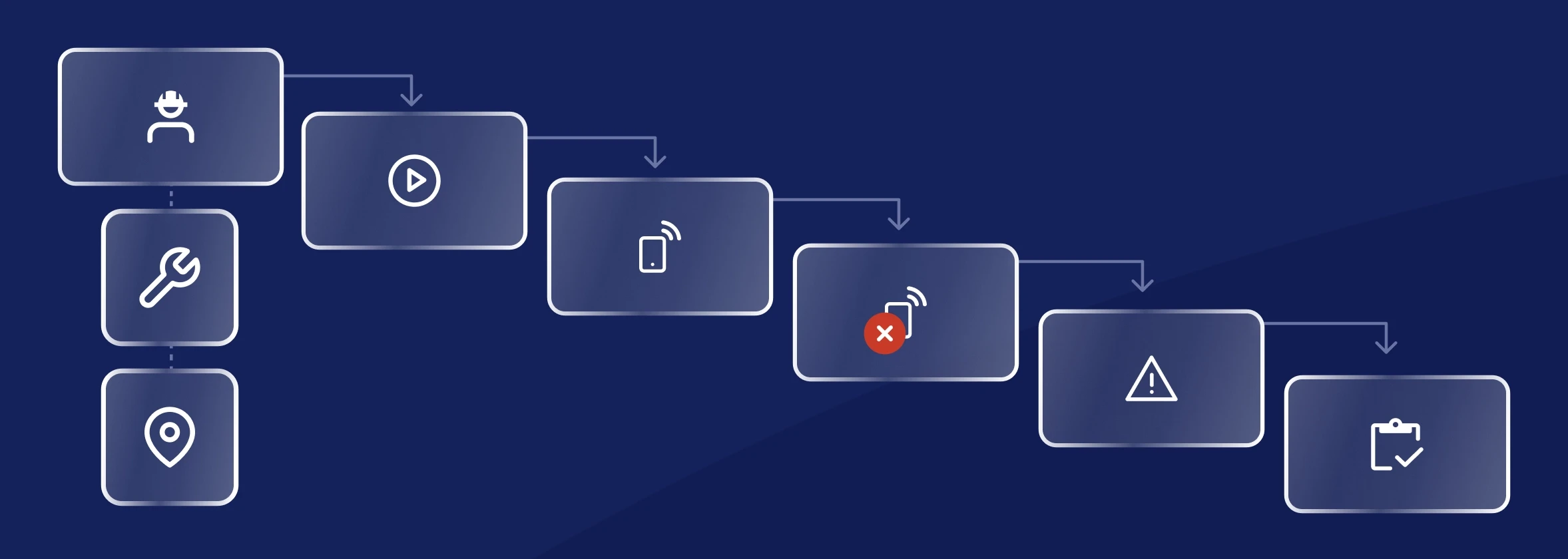
Reliable proof is created through a coherent chain of events. It shows what was planned for the assignment, which status updates were received, when a deviation was detected, who responded, and how the incident was resolved.

The article "Documented safety in the field is no longer optional" explains why this traceability is relevant for occupational safety, compliance, and corporate management. The article "Implementing risk assessments" explains how measures from risk assessments are translated into actionable processes. The following section focuses on the subsequent verification: Which data shows whether the established procedure was followed during the assignment?

At a glance

  • Verification connects the planned requirements with the actual course of the assignment.
  • Relevant events include the start of the assignment, status updates, deviations, responses, and completion.
  • Timestamps and assigned roles make response chains traceable.
  • Key performance indicators reveal recurring process gaps, but they always require the context of the risk and the type of assignment.
  • A high volume of data does not automatically improve verification. You should collect purpose-driven information that answers a specific safety question.
  • Digital systems make it easier to consolidate, analyze, and provide data on a role-based basis in chronological order.

When is a safety process verifiable?

A safety process is verifiable when its intended workflow can be compared with its actual execution. To achieve this, five questions must be answered:

Evidence levels of a safety process
Evidence level Guiding question Example evidence
Expectation Which process applied to this field assignment? Assigned person, location, activity, planned duration, check-in requirement
Execution Which expected events occurred? Assignment start, status update, extension, check-out
Deviation Where did the assignment deviate from the defined process? Missed check-in, exceeded time limit, alarm
Response How was the deviation handled? Notification, responsible role, contact attempt, escalation level
Outcome How was the case resolved? Contact established, false alarm clarified, further action initiated, assignment completed

Only by connecting these levels can you get a meaningful picture. For example, a single status update shows that a person responded at a specific time. However, without the underlying requirement, it does not show whether the notification was timely or what steps were planned in the event of a delay.

The Occupational Health and Safety Act also establishes a link between measures and their verification. According to Section 6 of the German Occupational Health and Safety Act (ArbSchG) , the required documentation must show the results of the risk assessment, the defined occupational safety measures, and the results of their review. The law does not mandate a specific digital event log. The operational data required depends on the activity, the risk, and the specific operational process.

For lone working in the field , this connection is particularly evident. DGUV Information 212-139 requires that the risks associated with lone working be identified, working conditions assessed, and appropriate measures planned and documented. The types of feedback, emergency call options, and verification methods that make sense therefore depend on the respective risk level.
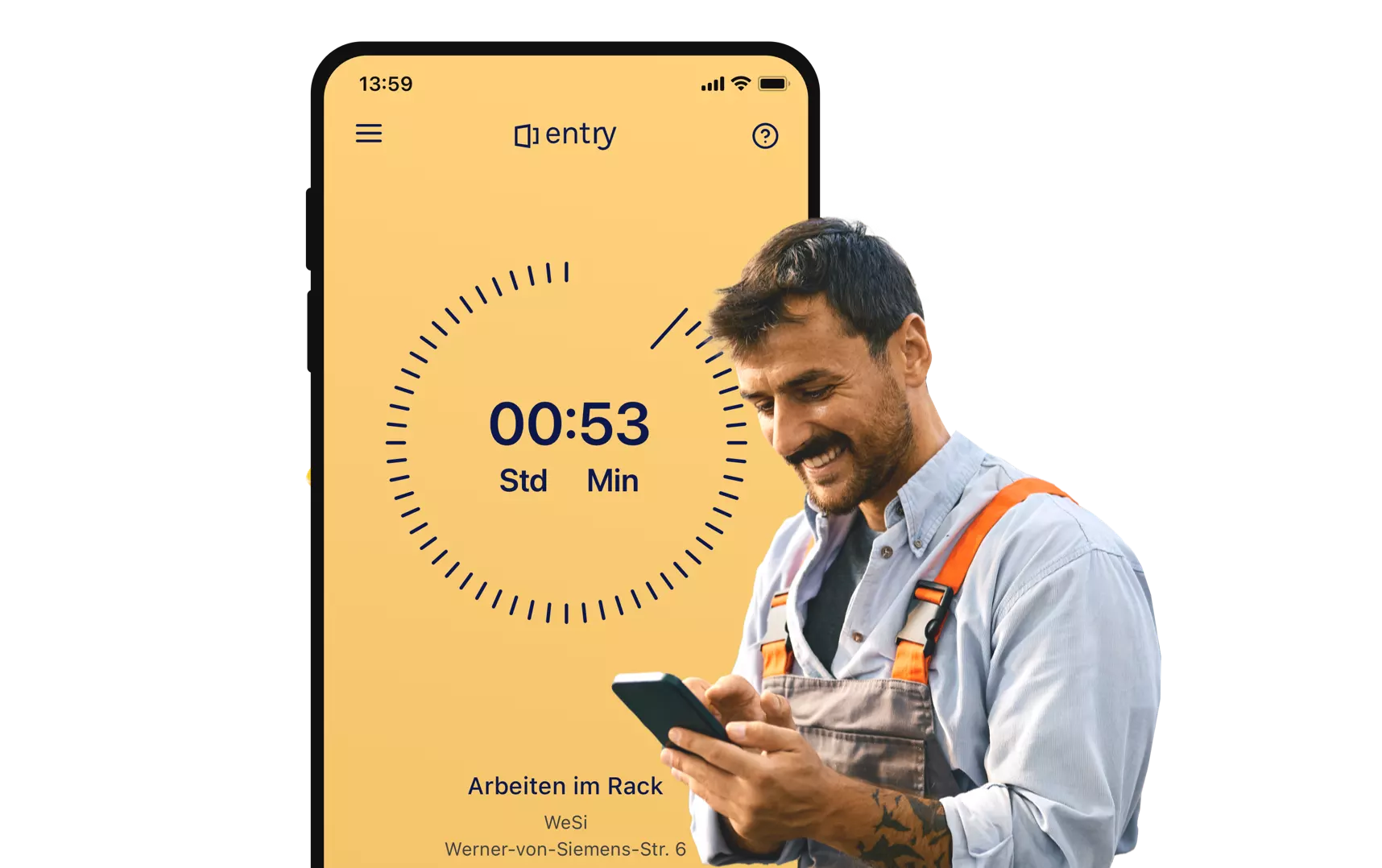
Manage technician deployments safely and efficiently

Manage technician deployments safely and efficiently

With Entry powered by Conntac, you can digitally secure your field operations – from dead man's switch to access management.

Manage technician deployments safely and efficiently

Which event data map the course of an operation?

For verifiability, the quality of the events is what counts. A well-structured dataset makes the sequence of events chronologically understandable and assigns a purpose to each event.

Requirements for the operation

Before an operation begins, it should be clear which safety process applies. This may include:

  • assigned person or role,
  • location and activity,
  • start time and expected duration,
  • required check-ins,
  • permitted time windows,
  • point of contact in case of a deviation,
  • applicable escalation rule.

This information forms the basis for comparison. Without it, a sequence of events can be reconstructed later, but whether it complied with the intended process remains unclear.

Status events during the operation

Status events show which planned steps have actually taken place. Depending on the operation, these can include:

  • check-in or start of operation,
  • confirmation of a safety function,
  • scheduled check-in,
  • change to the planned duration of the operation,
  • change in operation status,
  • check-out or completion of operation.

Every relevant event requires a precise timestamp and must be linked to the operation. With manual lists, phone calls, and disparate individual systems, these connections are often lost. A call may have taken place without the reason, result, and associated operation being clearly identifiable later on.

Deviations from the planned process

Good documentation also captures missing events. Examples include:

  • no response received within the defined time window,
  • the planned duration of an assignment is exceeded,
  • an alarm is triggered,
  • a connection or transmission channel is unavailable,
  • an assignment is ended without the intended completion status.

The deviation should appear as a separate event with a timestamp and type. This makes it possible to measure how quickly it was detected and whether the intended response path was initiated.

Responses and completion

For a complete response chain, the information "alarm triggered" is not enough. Those responsible must be able to track:

  • which department was notified,
  • when the notification took place,
  • who took over the processing,
  • which contact or verification steps were carried out,
  • whether a further escalation level was necessary,
  • how and when the process was completed.

This reveals whether the process worked through to the end. A detected alarm without documented processing remains organizationally unresolved.

The process chain for a field operation, from the start of the operation and feedback to the dispatch of the alarm and completion

What requirements should documentation meet?

Simply storing individual status data does not create reliable security documentation. Six quality criteria are crucial for future audits.

Completeness

All mandatory information defined for the respective process is present. Which information is mandatory depends on the type of operation and the risk assessment.

Chronology

Events can be traced in their actual sequence. Timestamps reveal the time elapsed between deviation, detection, notification, and response.

Clear Attribution

Every event is linked to a specific operation, location, and process. People with the same name, parallel operations, or shift changes must not lead to ambiguous attribution.

Accountability

Relevant actions and decisions are assigned to a specific role or authorized person. This makes it possible to verify whether the intended responsibility was exercised.

Context

An event is evaluated in conjunction with the applicable requirements. A response after 30 minutes may be on schedule for one operation but late for another.

Purpose Limitation

Only information necessary for security, operational management, and process evaluation is recorded. Access rights, retention periods, and evaluation purposes should be defined and communicated transparently. Continuous movement tracking is not required for many documentation purposes. Often, defined status events and location mapping are sufficient.

Example: How events are transformed into a verifiable process

A technician begins a scheduled assignment at a remote facility. This assignment requires a check-in within a defined time window. The following example illustrates the structure of a potential audit trail. Times and escalation levels are for illustrative purposes only; the specific configuration is determined by the risk assessment and operational policies.

Example of a traceable assignment timeline
Time Event Relevance to traceability
08:10 Assignment started Person, location and applicable process are assigned
08:40 Check-in due The expected event is derived from the defined process
08:42 Check-in missing The deviation is recorded as a separate event
08:43 Responsible team notified The start of the defined response chain is documented
08:46 Contact attempt initiated The responsible role and response time are traceable
08:49 Contact established The situation has been reviewed and clarified
08:52 Case closed The outcome and final status are documented

The dataset therefore answers more than just whether a check-in was missed. It also shows when the deviation was detected, how quickly the responsible party responded, and whether the process was fully completed.

Use case

How Entry supports the field service

One of our customers in the telecommunications industry uses Entry to digitize access control to important systems. Before the introduction of Entry, the processes were time-consuming. After implementation, the company was able to reduce access times, to significantly increase security standards and to increase field staff satisfaction through clear and transparent processes.
Use case: How Entry supports the field service

Which metrics indicate the quality of the safety process?

Individual assignment logs help with case reviews. Metrics make recurring patterns visible across multiple assignments. They should be broken down by assignment type, risk level, location, or the responsible organizational unit.

Safety process quality metrics
Metric Calculation or guiding question What it indicates
Context completeness For how many assignments are all defined mandatory details available? Shows whether assignment data supports reliable analysis
On-time check-in rate How many expected check-ins were received within the defined time window? Indicates adoption and practical suitability of the check-in process
Deviation rate For how many assignments did at least one defined process deviation occur? Shows where processes regularly deviate from the expected workflow
Detection time How much time passed between the expected event and detection of the deviation? Measures how quickly the process identifies a gap
Response time How much time passed between detection and the first documented response? Evaluates operational availability and clear ownership
Escalation closure rate How many escalations have a clearly documented final status? Shows whether response chains are completed and fully documented
Recurrence rate How often does the same deviation recur in comparable assignments? Identifies structural issues in the process, technology or training

Metrics do not provide an automatic assessment of safety. A high deviation rate, for example, may point to impractical check-in intervals, technical issues, unclear responsibilities, or particularly demanding working conditions. Only by considering the metric and the assignment context together can reliable conclusions be drawn.

How can misinterpretations be avoided?

Four rules help with the evaluation:

  1. Group comparable assignments: Routine assignments and high-risk activities require separate evaluations.
  2. Check data quality first: Missing timestamps or ambiguous assignments can distort metrics.
  3. Investigate the causes behind deviations: A delayed check-in can be caused by operation, reception, process design, or an actual emergency.
  4. Connect measures and impact: After a process adjustment, it should be verified whether the check-in rate, response time, or recurring deviations change.

This turns documentation into a foundation for the continuous improvement process. Those responsible can identify where a process becomes unstable and which adjustments actually have an effect.

What technical requirements support auditability?

A digital system should consolidate security-relevant events in such a way that authorized personnel can manage operations in real time and evaluate them later. The following functions are particularly relevant for this:

  • clear assignment of individuals, roles, locations, and assignments,
  • automatic timestamps for relevant events,
  • real-time status overview for ongoing assignments,
  • detection of defined deviations,
  • documentable notification and response steps,
  • role-based access rights,
  • filter and export options for evaluations,
  • interfaces to existing location, assignment, or service master data.

Professional risk assessment and operational procedural rules remain the foundation. The digital system maps the established process and provides the data used to verify its execution.

How Entry consolidates assignment data and status information

Entry connects the smartphone app for technicians with the Conntac dashboard for the responsible department. Technicians can check in at locations, report their assignment status, and confirm completion. Ongoing work and current status information are visible in the dashboard. If a scheduled check-in is missed, the access point can be flagged accordingly and a security notification triggered. Further responses follow the company's specific procedural rules.

User and role management, location data, and interfaces help assign events to the correct organizational context. This creates a common data foundation for operational management, case review, and the analysis of recurring process deviations.

Further basics on roles and responsible entities explain the know-how regarding technician management and the Network Operations Center.

The Entry App and Conntac Dashboard link status updates from field staff to the appropriate department

Self-check: Can you evaluate your security process?

These questions will help determine if your existing documentation is sufficient for control and auditing:

  1. Is it clear for every deployment which feedback and escalation process was in effect?
  2. Can expected status events be compared with those actually received?
  3. Are missing feedback and other deviations recorded with a precise timestamp?
  4. Is it traceable which role took action in response?
  5. Does every escalation have a documented final status?
  6. Can comparable deployments be evaluated together?
  7. Are recurring deviations translated into concrete process improvements?

Several unanswered questions indicate a gap between operational documentation and systematic process evaluation.

Frequently asked questions about the verifiability of security processes

What data must be documented for field operations?

There is no single list of data requirements that applies to all field operations. The necessary information depends on the specific activity, risk assessment, protective measures, and operational procedures. For process auditing, requirements, status events, deviations, responses, and final outcomes are generally relevant.

Is documented feedback sufficient as proof?

A single piece of feedback only confirms an event. To evaluate the entire process, the applicable workflow, potential deviations, the response from the responsible department, and the final outcome are still missing.

Is it necessary to record locations and movements permanently?

Data collection should be guided by the security purpose. For many processes, assigning an assignment to a location along with defined status events is sufficient. Companies should review the scope of data collection, access rights, storage duration, and the involvement of relevant internal departments from a data protection perspective.

Which metric should be looked at first?

Contextual completeness is a sensible starting point. If mandatory information, timestamps, or clear assignments are missing, downstream metrics such as feedback rates and response times lose their significance.

Conclusion: Accountability begins with data correlation

Accountable safety in field service is achieved when the intended process can be compared with the actual course of an assignment. This requires a clear chain of events consisting of requirements, execution, deviations, responses, and results.

Timestamps, roles, and completion statuses make individual operations auditable. Metrics reveal whether process gaps recur across multiple assignments. This provides supervisors, safety officers, and management with a reliable basis for specifically improving feedback channels, responsibilities, and escalation procedures.

See how Entry brings together assignment status, missing feedback, and responsible parties into a unified process.

Sources

Photo of Johanna Kugler
Johanna Kugler

Content Marketing Manager

Become a Conntac Insider

Subscribe to our LinkedIn newsletter The Conntac Chronicles to receive relevant insights and perspectives on current topics and challenges in the field of modern service solutions.

Woman high fiving another person