What decision makers need to consider in the field in 2026
The technical field service in the utility sector works under conditions where risks are real: in shafts, confined technical rooms or during emergency operations at night.
In 2026, the focus of many organizations will therefore shift significantly. The focus is no longer solely on technical protection measures – but on the comprehensible organization of responsibility.
For management and division managers, this means that security measures not only have to be in place. In an emergency, you must have demonstrably worked.
Safety is a management task – not a secondary issue
Security in the field is often regarded as an operational task. In practice, however, the responsibility lies with the organization.
Regulatory authorities, auditors and certification bodies are therefore increasingly examining three questions:
- Have risks been systematically assessed?
- Are there defined security processes?
- Is their use comprehensibly documented in case of use?
It is therefore not only the measure itself that is decisive, but the organizational security behind it.

Why TSM requirements focus more on documentation
Technical Safety Management (TSM) is currently tightening the requirements for documenting field service deployments. Emergency service is particularly relevant. It is precisely there that this creates additional coordination loops. A lot of feedback is received by telephone, which further increases the coordination effort between control center and field service. Many energy suppliers report from practice that TSM certification increasingly requires complete documentation of the deployment chain.
These include, for example:
- Feedback when a mission starts
- Status messages during activity
- Documentation of the return after completion of the mission
In some cases, employees are even expected to provide final feedback after returning home.
The background is understandable: This is the only way to prove that employees were covered throughout their entire working time.
Where manual readiness processes reach their limits
Many organizations still meet these requirements using traditional means:
- telephone feedback
- Excel lists
- manual notes in control centers
However, these methods only work to a limited extent in everyday life. This creates additional coordination loops, especially when on call. A lot of feedback is received by telephone, which further increases the coordination effort between control center and field service.
Typical consequences are:
- additional coordination effort
- frequent inquiries between control center and sales force
- incomplete documentation of individual steps
It is precisely at these points that liability risks arise later on because processes can no longer be clearly reconstructed.
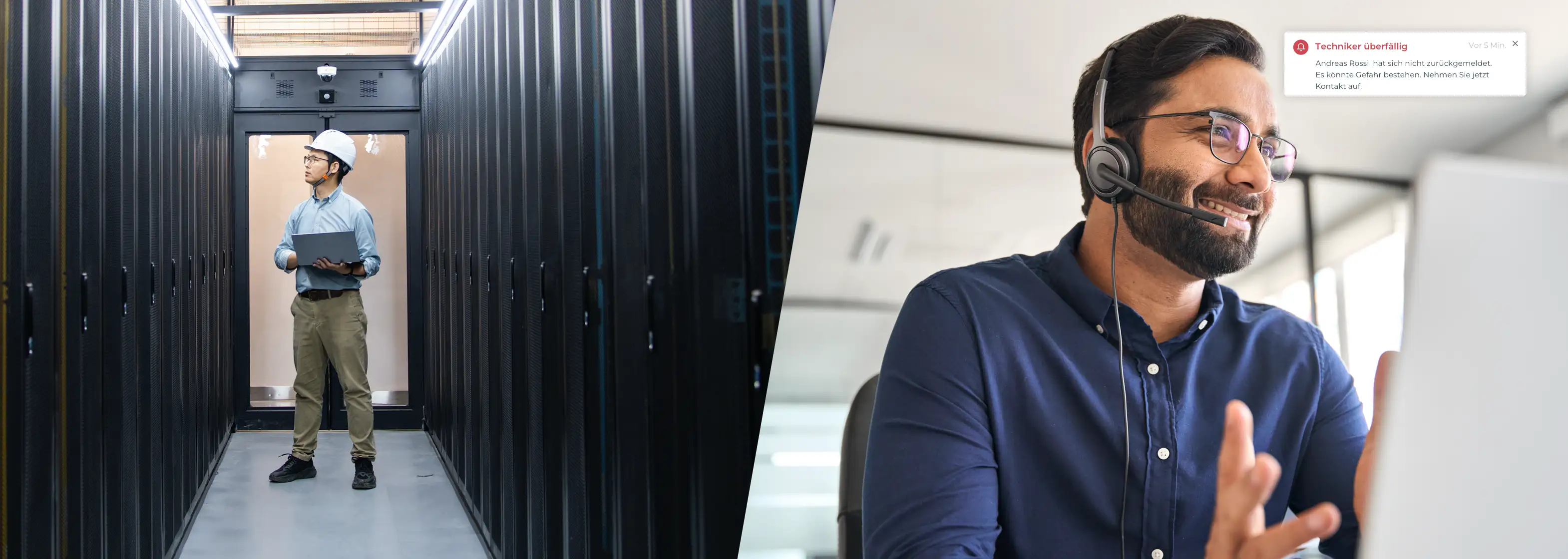
Why alarm channels must work regardless of ideal conditions
Another critical point concerns the reliability of alerting processes. Many safety solutions only work under ideal conditions – for example with stable mobile phone reception or active operation by the technician.
In reality, however, everyday working life looks different:
- Technical rooms are often located in cellars
- Shafts or plant areas have poor reception
- Stressful situations can prevent manual reporting
For those responsible, there is therefore a central question: What happens if a technician is no longer able to react himself?
For this reason, there is a central principle for modern safety concepts: Alerting processes must be effective even when employees are unable to react actively.
For more on this topic, read the article “Deadman's Switch for Working Alone.”
Why processes are more important than individual tools
Organizations that organize safety in a stable manner over the long term are therefore pursuing a process-oriented approach.
The focus is on three elements:
1. Clear responsibilities
In the event of an alarm, who is the defined remote station?
2. Automated escalation logic
What happens if there is no response?
3. Complete documentation
How can the process be traced later?
Technical solutions can support these processes – but the organizational structure remains decisive.
Conclusion: Comprehensible processes are becoming a central safety factor
The development in technical safety management clearly shows that safety in the field is increasingly seen as an organizational responsibility.
For companies, this means:
- Deployment processes must be clearly defined
- Alarm paths must function reliably
- Processes must be comprehensibly documented
Digital systems can help to implement these requirements in a structured manner and at the same time reduce administrative work in the field. For organizations with regular TSM certifications, comprehensible documentation of the readiness process is increasingly becoming a decisive selection criterion for digital solutions.
Would you like to clearly structure safety processes in the field and reliably meet TSM requirements?
Find out how digital process solutions like Entry help public utilities and network operators to organize safety processes transparently and at the same time reduce coordination efforts in everyday life.
FAQ: Safety and TSM compliance in the field
For whom are the TSM requirements particularly relevant?
The requirements primarily concern technical managers and safety managers at municipal utilities, network operators and service organizations.
Companies with regular TSM certifications must document their processes particularly precisely to ensure solo work and on-call services.
Why is it often no longer sufficient to report the start and end of deployment?
Complete documentation of the entire operational chain is increasingly expected.
This includes status messages during deployment and confirmation of safe return after completion of the activity.
What role does digital documentation play in liability?
Digital processes enable objective and comprehensible documentation of alarm routes and feedback.
In an emergency, this traceability can be decisive to prove compliance with organizational obligations.
Do modern safety solutions also work when reception is poor?
Professional solutions take into account situations with limited network coverage.
Time-based escalation mechanisms or server-side logics can ensure that alarm processes take effect even if a device has no reception for a short time.
How can administrative costs be reduced through TSM requirements?
Instead of telephone lists or manual documentation, digital systems can automatically record status messages.
This reduces coordination costs, while at the same time creating complete documentation.